
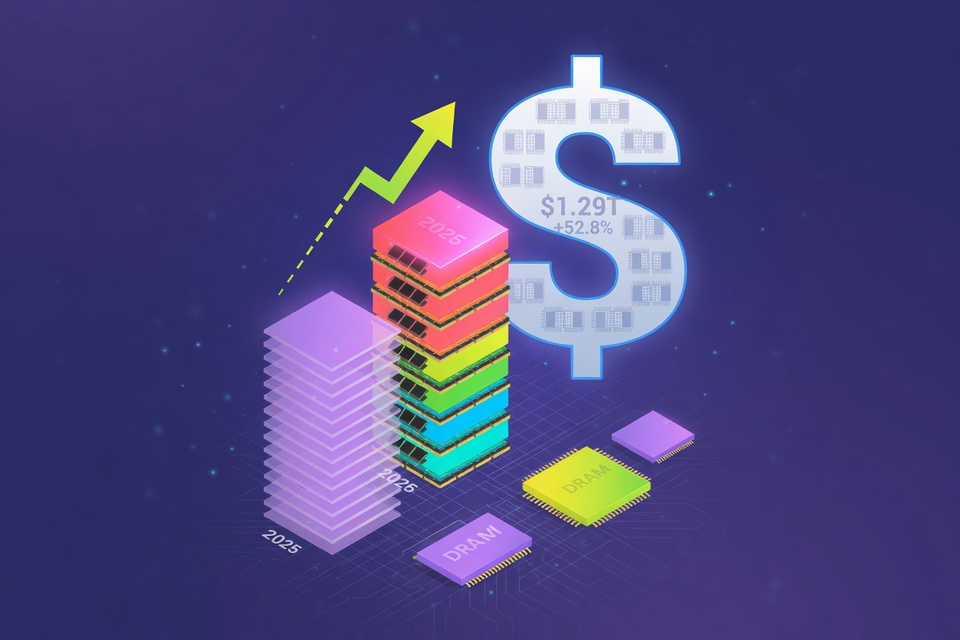
IDC forecasts global semiconductor revenue of $1.29 trillion in 2026, up 52.8 percent from $842.8 billion in 2025, and memory supplies most of the increase.
Total memory revenue rises from $226 billion in 2025 to $594.7 billion in 2026 and $790.4 billion in 2027. Non-memory reaches $693.5 billion in 2026. DRAM alone is forecast at $418.6 billion, up 177 percent year over year; NAND flash at $174.1 billion, up 138.5 percent.
Run those figures against each other and memory accounts for roughly 83 percent of the year's revenue growth. That number is derived from IDC's own components rather than stated by IDC: memory adds $368.7 billion while the memory plus non-memory total adds $445.4 billion. The trillion-dollar milestone is a repricing event wearing a growth headline.
Jeff Janukowicz, Research VP, Semiconductors & Semiconductor Manufacturing at IDC, makes the case for a break in the cycle. “The memory market is at an unprecedented inflection point, with demand materially outpacing supply. For an industry long characterized by boom-and-bust cycles, this time is different.” Every memory analyst says this time is different at the top of every cycle. What makes the claim testable is the supply side, and IDC gives dates.
On HBM, IDC says most capacity is pre-committed through 2026 with forward allocations extending into 2027, concentrated in NVIDIA and AMD GPU platforms and hyperscaler custom silicon programs, and that meaningful new supply will not arrive until late 2026 at the earliest. Translated for anyone buying: if a 2026 allocation is not signed, price is not the lever, and the 2027 book is filling.
Per-bit costs for HBM run several times standard DRAM, the firm says, because of the advanced packaging and stacking involved, and each HBM chip consumes more silicon area, further tightening availability of other types of DRAM. Conventional DRAM pricing is therefore downstream of HBM's silicon appetite, not a separate event.
NAND is repricing more broadly. IDC attributes demand to training datasets, checkpoint storage and high-performance inference, and says enterprise SSD prices have surged as hyperscalers secure supply, tightening availability across consumer and OEM channels. Storage buyers outside the hyperscale tier are paying for someone else's checkpoints.
Somebody funds this. Mobile semiconductor revenue is forecast to decline to $89.8 billion in 2026, which IDC attributes not to weak consumer demand but to memory taking a larger share of the bill of materials and forcing tradeoffs between margin, pricing and specification.
Data center silicon is the counterweight at $477.1 billion in 2026, reaching $843.2 billion by 2030 on a base case of $1.75 trillion in total revenue that year. Within that, the intelligent datacenter category covering CPUs, AI accelerators, custom ASICs and networking silicon is put at $281 billion.
Nina Turner, Research Director, Semiconductors at IDC, goes further. “AI infrastructure has reset the demand baseline, memory has repriced as a strategic asset, and the industry’s growth trajectory through 2030 is no longer contingent on a consumer refresh cycle.” The permanence claim rests on the IDC Semiconductor & Semiconductor Applications Forecast of April 2026, whose methodology is not published alongside these numbers. The same page also states that "the i4" will raise capex 70 percent to roughly $600 billion in 2026, without saying anywhere who the i4 are.



Leave a Reply