
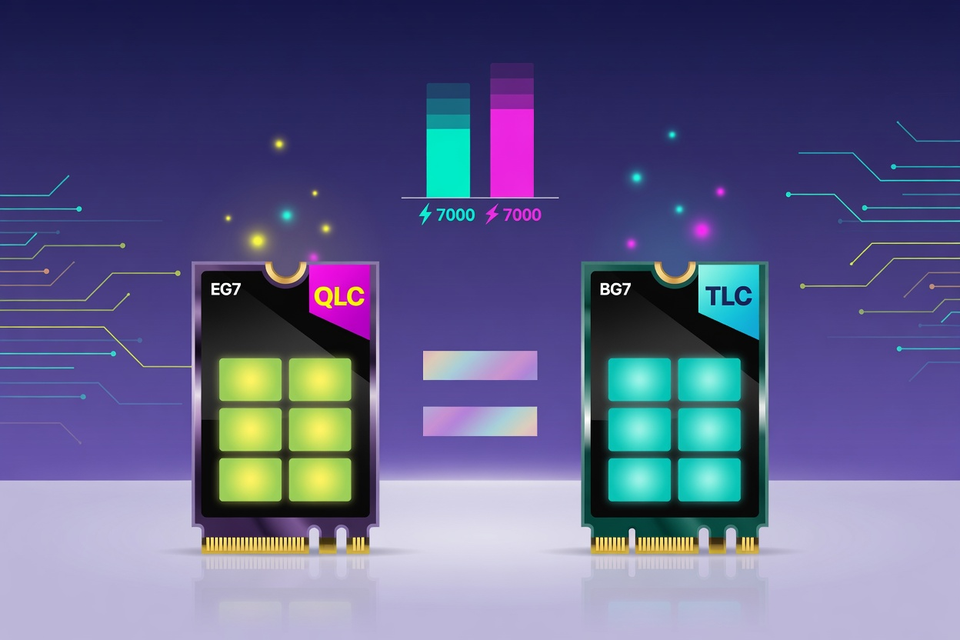
Kioxia has launched the EG7 Series, its first client SSD line built on BiCS FLASH generation 8 quadruple-level cell flash, aimed at PC OEMs.
The headline claim is that QLC now performs like TLC. Kioxia America's release says the EG7 "delivers identical performance as TLC-based solutions"; the Kioxia Corporation release out of Tokyo words the same claim as "equivalent performance as TLC-based solutions". Both hang a footnote off it, and the footnote is the whole story: the comparison is against the BG7 Series, Kioxia's own previous value client drive. This is not QLC matching the TLC market. It is QLC matching one specific Kioxia TLC part on published specifications.
Read the numbers with that in mind. Random read and write top out at 1,000 KIOPS, sequential read at 7,000 MB/s and sequential write at 6,200 MB/s, on a drive the release describes as PCIe 4.0 specification compliant. Capacities are 512 GB, 1024 GB and 2048 GB across M.2 2230, 2242 and 2280, with NVMe 2.0d support and TCG Opal 2.02 self-encryption where the region allows it.
The EG7 is DRAM-less and leans on Host Memory Buffer, which Kioxia describes as using a portion of system memory to help improve total cost of ownership and power consumption. That is the standard cost lever in this segment. It takes a component off the board and makes the drive's behaviour more dependent on the host it lands in.
“QLC technology continues to expand what’s possible in client storage by delivering compelling value without compromising user experience,” said Neville Ichhaporia, senior vice president and general manager of the SSD business unit, KIOXIA America, Inc. “With the EG7 Series, we’re enabling PC OEMs to bring high-performance, power-efficient storage to a broader range of systems at a more accessible price point.”
Decoded: Kioxia is putting four-bit-per-cell flash into notebooks and selling the swap on cost per gigabyte. The release says as much in a footnote, which reads that QLC-based products cost less per gigabyte with the same performance and can help reduce total cost of ownership, then adds that this is subject to change. A footnote that marks the value proposition itself as subject to change is unusual candour for a product launch.
Every other superlative in the announcement carries a similar leash. The power efficiency claim is measured against BiCS FLASH generation 5, three generations back. The TCO and power consumption claim for the DRAM-less design is measured against the XG Series, which contains DRAM, on pricing and published specifications. None of those baselines is a competitor's part.
What the release does not carry is a price, an endurance rating, or any sustained write figure for the state the drive reaches once its cache is full, which is where four-bit cells usually show their hand. The EG7 is sampling with selected PC OEM customers, and systems built around it are expected to ship in the second quarter of 2026.
Bootnote: the same release devotes a long note to explaining that Kioxia counts a gigabyte as 1,000,000,000 bytes while an operating system reports capacity in powers of two, so the 2048 GB model shows less capacity than its name once it is formatted. It is boilerplate, and it is also the gap between what a purchasing manager signs for and what the person using the laptop sees.

Leave a Reply