
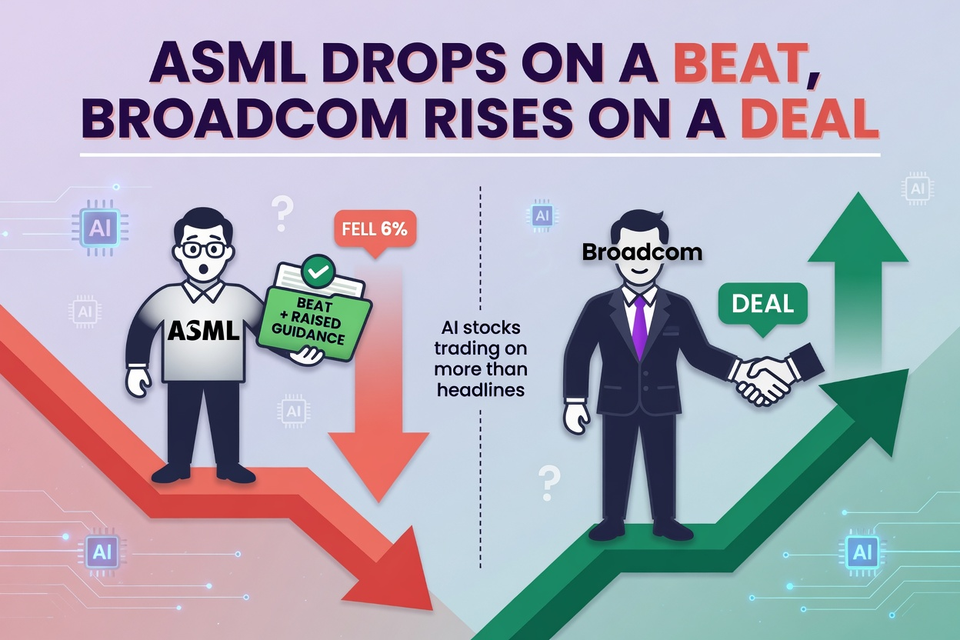
ASML shares fell 6% after the company beat first-quarter estimates and raised its full-year sales guidance, a reminder that AI-linked stocks are trading on more than the headline numbers right now.
The Dutch lithography maker reported net sales of 8.8 billion euros and net profit of 2.8 billion euros, both ahead of LSEG consensus estimates of 8.5 billion euros and 2.5 billion euros. ASML also lifted its 2026 sales outlook to a range of 36 billion to 40 billion euros, up from 34 billion to 39 billion euros previously. The selloff tracked instead to China. A bipartisan group of U.S. lawmakers has proposed legislation that would cut off ASML's sales of its lower-end deep ultraviolet machines to Chinese chip companies, and system sales to China already fell to 19% of the quarter's total from 36% in the prior quarter. Memory customers took a bigger share of new tool sales, rising to 51% from 30%, with South Korea alone accounting for 45% of sales.
Chief executive Christophe Fouquet tied the results to AI demand rather than the China exposure. "The semiconductor industry's growth outlook continues to solidify, driven by ongoing AI-related infrastructure investments," he said. "Demand for chips is outpacing supply. In response, our customers are accelerating their capacity expansion plans for 2026 and beyond, supported by long-term agreements with their customers." It was the first quarter in which ASML did not disclose order intake as a headline figure, a change some investors read as a loss of visibility. Ben Barringer, head of technology research at Quilter Cheviot, argued the market was already ahead of the news anyway. "The market had been a little perturbed by ASML dropping its order numbers, but this is something it will need to get used to and there is enough other data out there to hold the company to account," he said.
A separate stock moved the other direction. Meta committed to deploying its first gigawatt of custom Training and Inference Accelerator chips built on Broadcom technology, part of a partnership the two companies extended through 2029, and Broadcom shares rose 3% in extended trading on the news while Meta's stock stayed flat. The deal follows one two weeks earlier in which Broadcom struck a long-term agreement to build Google's TPU chips, with Anthropic securing access to 3.5 gigawatts of that Google capacity. Broadcom chief executive Hock Tan, who is also leaving Meta's board after two years, addressed the accelerator roadmap directly on the company's March earnings call. "Now, contrary to recent analyst reports, Meta's custom accelerator, MTIA roadmap is alive and well," he said. "We're shipping now and, in fact, for the next generation XPUs, we will scale to multiple gigawatts in 2027 and beyond." Broadcom's stock had already gained about 10% since the start of the year, versus roughly 2% for the S&P 500, before this latest deal landed.
Both moves say less about AI demand, which both companies described as strong, than about how narrowly investors are now reading each earnings call and each customer deal for signs of where that demand actually lands.



Leave a Reply