
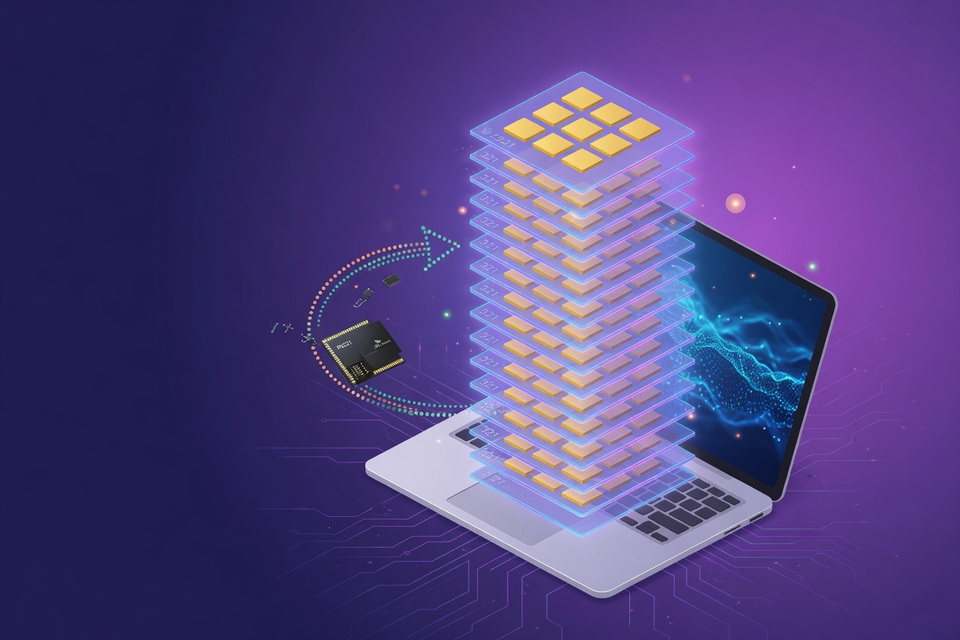
The drive headed into the next wave of AI laptops is stacked 321 storeys high. SK hynix said on April 8 that it has begun supplying the PQC21, a client SSD built on the company's first 321-layer QLC NAND flash, and Dell Technologies is first in the queue.
Stacking is the whole trick in modern flash memory. Chipmakers ran out of room to shrink cells sideways years ago, so they started building upward instead, layer on layer, rather like adding floors to a car park instead of paving more of the field next door. Three hundred and twenty-one floors is where this generation has landed.
QLC, which everyone says as three separate letters, is the other half of the story. It stands for quad-level cell, and it means a single memory cell holds four bits rather than one. A one-bit cell is a light switch, on or off. A four-bit cell has to tell sixteen different voltage levels apart, which is closer to reading somebody's handwriting than flipping a switch, and that is exactly why QLC packs in the capacity while asking a great deal more of the controller reading it back.
Two capacities are on offer, 1TB and 2TB. The company describes the pairing of high-layer stacking with QLC as the core of the product, the point being that capacity per unit area is what a laptop maker is actually buying.
To stop the writes feeling sluggish, the drive leans on SLC caching. The controller runs a slice of the array in one-bit mode, which is fast, takes incoming data there first, then quietly re-files it in four-bit form afterwards. Frequently accessed data gets the quick lane. Everything else gets put away properly when nobody is looking.
"The supply of the 321-layer QLC-based cSSD marks an important milestone that demonstrates our leadership in the AI PC market," said an SK hynix official in the announcement. "We will continue to lead the high-performance NAND solution market on the strength of our overwhelming technological capabilities."
Grand as that sounds, the numbers underneath it are the interesting part, and several of them are missing. No sequential read or write figures have been published for the PQC21, no endurance rating, and no price. Endurance is usually the first specification a buyer asks about on a QLC drive, because four-bit cells wear out faster than three-bit ones do.
The market bet is easier to read. Citing IDC, SK hynix says QLC's share of the global client SSD market is expected to grow from 22 percent in 2025 to 61 percent in 2027. Should that hold, the client drive business would tip from mostly three-bit TLC to mostly QLC inside two years, and the supplier with the highest layer count shipping in volume would get to price accordingly.
Dell as the launch customer matters more than it looks. Client SSDs are won on OEM design slots rather than retail shelves, and qualification is a long, unglamorous grind through firmware, thermals and warranty arithmetic. Samsung, Micron, Kioxia and Sandisk are all chasing the same slots.
Full-scale supply to Dell starts in April, and SK hynix says it plans to keep expanding to other major global customers from there.


Leave a Reply