
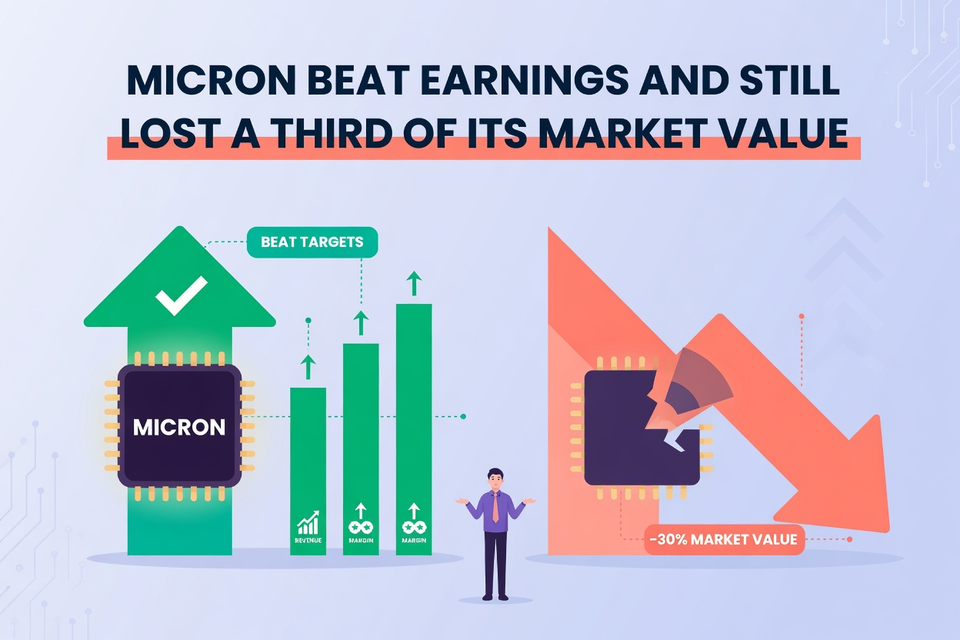
Micron's stock fell 10 percent in a single trading session and is down roughly 30 percent since the company's blowout March 18 earnings report, even after Micron beat Wall Street's revenue and margin targets by a wide margin. CNBC reports the sell-off reflects investor unease about what comes after the current supply crunch, not doubt about the crunch itself.
Fiscal second-quarter revenue came in at $23.86 billion, nearly triple the $8.05 billion Micron reported a year earlier, with guidance for gross margins near 80 percent in the current quarter. Chief executive Sanjay Mehrotra told CNBC that key customers are still only receiving "half to two-thirds of their requirements," a supply gap that has underpinned pricing power all year.
New numbers from research firm SemiAnalysis, carried by Tom's Hardware, help explain why that gap has not translated into a straightforward stock rally. The firm estimates memory will absorb roughly 30 percent of hyperscaler capital spending in 2026, up from about 8 percent in 2023 and 2024, and expects that share to climb again in 2027, a near fourfold jump in four years. Against a projected $250 billion in incremental hyperscaler spending for 2026, memory accounts for a substantial share of where that new money actually goes.
DRAM prices are on pace to more than double this year, and SemiAnalysis expects high bandwidth memory, the stacked chips at the center of AI accelerators, to stay undersupplied through 2027. New capacity from projects such as Micron's $9.6 billion Hiroshima facility and SK hynix's own expansions will not add meaningful output until 2027 or 2028, meaning the current squeeze has years left to run rather than months. Separately, Counterpoint Research projects that standard 64GB DDR5 server modules, the memory type most enterprise servers actually use, could cost twice as much by the end of 2026 as they did at the start of 2025.
Not every buyer feels the squeeze equally. SemiAnalysis says Nvidia receives what it calls VVP, or Very Very Preferred, pricing from memory suppliers that runs "well below" the rates both hyperscalers and the broader market pay, cushioning Nvidia's costs while making the underlying shortage harder for competitors to see. AMD, which the firm says needs more memory per accelerator than Nvidia and buys at lower volume with no comparable pricing arrangement, is left more exposed to the same supply constraints Micron's numbers describe.
Put together, the two data points argue that Micron's earnings beat was real and its stock drop was not really a verdict on Micron. Investors are pricing in years of elevated capital spending across the memory supply chain, uncertain how much of it finds a buyer at today's prices once new HBM capacity starts landing in 2027 and 2028.



Leave a Reply