
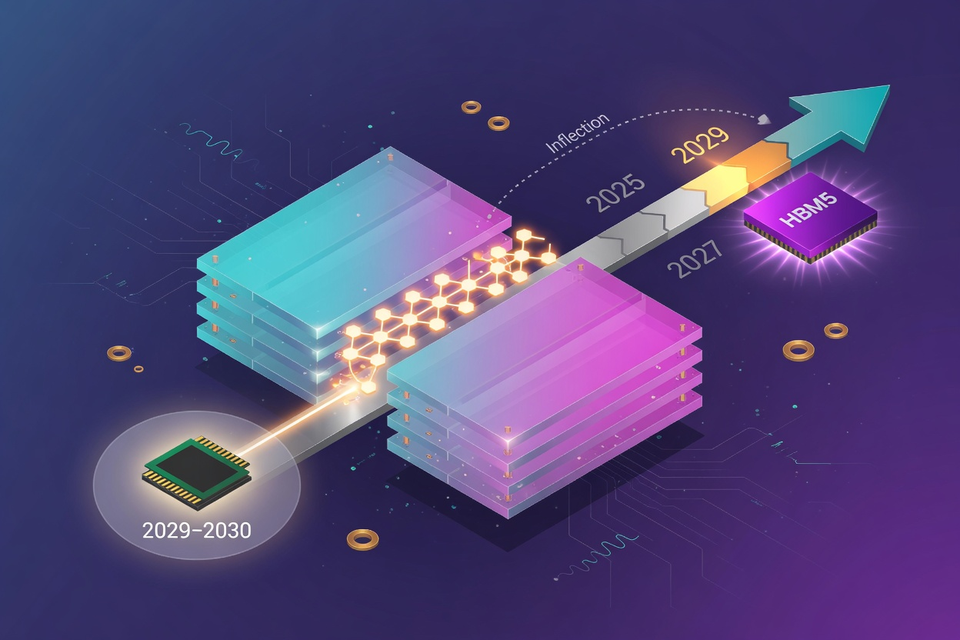
Counterpoint Research has put a date on hybrid bonding's arrival in volume HBM manufacturing, and it is later than the current tool-buying suggests: mass adoption comes only at HBM5, a generation the firm expects SK hynix to introduce in 2029 or 2030.
The insight note, written by analyst Ashwath Rao, argues that micro-bumps are running out of road. Signal integrity, power efficiency and thermal performance all degrade as stacks grow, and 20-plus-layer stacks are pressing against physical height limits inside GPU packages. Hybrid bonding's answer is copper-to-copper contact at sub-10µm interconnect pitch, against 20µm to 40µm for micro-bumps, with lower stack height and higher bandwidth and energy efficiency thrown in.
Rao is direct about the timing. "HBM5 is going to be the true inflection point for hybrid bonding, enabling >20-layer stacking, finer pitch, and next-level bandwidth while requiring breakthroughs in CMP, yield, and cost to scale into high-volume manufacturing," the note says. Decoded, that means HBM4 still ships on bumps. JEDEC has relaxed HBM height specifications to let thermal compression bonding stretch to 16 layers, and Counterpoint notes that postponing the switch cuts capital intensity and keeps yields on a mature process, even as Samsung, SK hynix and Micron all continue advancing hybrid bonding for HBM4 and beyond.
Where the note earns its keep is on CMP. "In hybrid bonding, CMP becomes mission-critical, as bonding relies on ultra-flat, atomically smooth surfaces," Rao writes, adding that "Any CMP defect like Cu dishing, erosion, or contamination directly impacts yield, resistance, and reliability." That is the polishing step promoted from stagehand to co-star, and it explains why SK hynix is procuring an integrated line that couples Applied Materials' CMP and surface preparation with Besi's hybrid bonder rather than assembling separate tools itself: Counterpoint says the package is aimed squarely at surface uniformity, Cu dishing, particle defects and ultra-tight roughness control.
Demand-side timing backs the roadmap. Nvidia's bandwidth requirements effectively set the HBM plans of all three suppliers, Counterpoint argues, and the firm sees the memory squeeze hardening into a structural supply shortage that lasts through 2030, with 2028 the likely inflection point as a new wave of production clusters ramps. "We expect SK Hynix to introduce HBM5 in 2029-2030, aligned with next-generation AI GPU cycles, with hybrid bonding reaching mass adoption at the HBM5 node to enable higher performance and efficiency," the note concludes.
There is a warning for the toolmakers buried in the same document: JEDEC's height relaxation could delay hybrid bonding adoption, "extending TCB's lifecycle and creating uncertainty in equipment demand." Read that as a reminder that today's bonder orders are options on 2029, not the start of a ramp. Counterpoint's own position is that the head start still pays, arguing early adoption of the Applied Materials and Besi flow gives SK hynix a strategic advantage on bandwidth, latency, power and speed regardless of interim standard relaxations, which is another way of saying the learning curve is the product and SK hynix just bought a seat at the front of the class.



Leave a Reply