
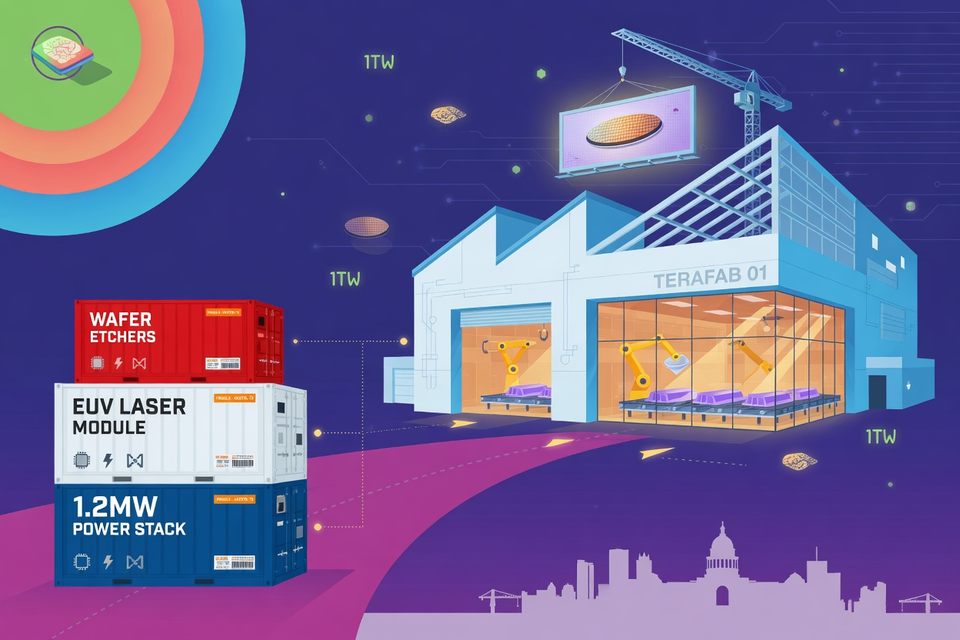
Elon Musk wants to stop buying AI chips from other people and start baking them himself. The plan is called Terafab, it runs across Tesla, SpaceX and xAI, and its first building is meant to go up in Austin, Texas.
A fab, short for fabrication facility, is where blank silicon wafers go in one end and finished processors come out the other. Picture a bakery in which the ovens cost billions of dollars each and a single speck of dust ruins the loaf. Terafab would fold chip design, fabrication, testing and packaging into one operation, which is an ambitious quantity of bakery for a group that has never run one.
The number attached to the pitch is why anyone is paying attention. Data Center Knowledge reports that Musk said the effort could ultimately support up to one terawatt of compute annually, and describes that as a level far beyond today's data center capacity benchmarks. A terawatt is a trillion watts. Nobody has built anything close.
Output would feed Musk's own machines, from autonomous vehicles and humanoid robots to compute systems in orbit. Siting the plant in Austin puts it near Tesla's existing Gigafactory, close enough that silicon designers and production engineers could argue in the same corridor.
Analysts quoted by Data Center Knowledge are split, and the split is not about whether the world needs more fabs. Steven Dickens of HyperFrame Research told the publication that the US certainly needs onshore chip fabs, and that X, Tesla and SpaceX will each need large volumes of chips, which sits comfortably with Musk's preference for owning the whole stack. Patrick Moorhead of Moor Insights and Strategy wrote in a LinkedIn analysis that the foundry capacity gap running to 2030 is real and that the case for more domestic capacity is sound.
Then comes the part that matters if you have ever watched a fab go up. Moorhead wrote that what happened was a presentation rather than a fab, with no orders placed with ASML, KLA or Applied Materials, no named process partner and no manufacturing team. He also wrote that a 2 nanometer fab cannot be built without a production-ready process flow from someone, and called that the foundation rather than a detail. ASML builds the lithography machines that print circuit patterns onto wafers, and its most advanced tools ship in quantities you can count on your fingers.
Jack Gold of J. Gold Associates pushed on a different question, which is whether anyone outside Musk's companies would want this. He told Data Center Knowledge that the industry is moving toward standardized, modularized AI factories, closer to prefabricated construction than to bespoke builds, and said he is not sure how many hyperscalers would buy into the approach, though it might appeal to new entrants.
Musk has also sketched a roadmap in which AI workloads migrate to orbit, powered by solar and carried on satellites, which would sidestep terrestrial grid limits altogether. That is the argument the whole sector is having about power, taken to its furthest edge.
Terafab is a presentation with a very large number on it. The chips are the easy part to describe and the hard part to make.


Leave a Reply