
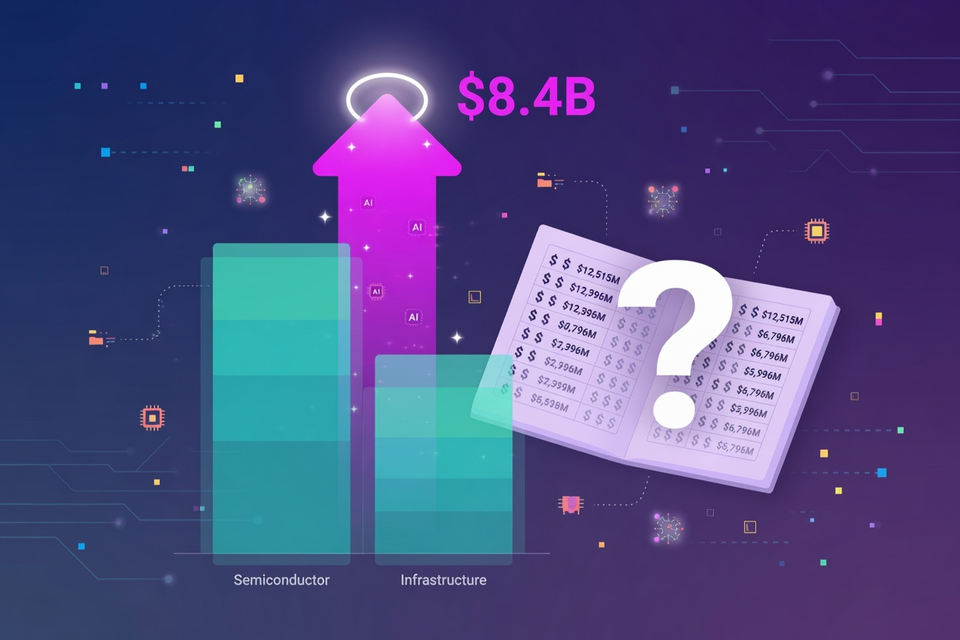
Broadcom reported $19,311 million of revenue for the fiscal first quarter, which ended February 1, 2026, and sorted it into two segments. Semiconductor solutions brought in $12,515 million and infrastructure software $6,796 million. No line in any of the tables is labelled AI.
The figure everyone wants sits in a quotation instead. Hock Tan, president and chief executive, said in the release: "Broadcom achieved record first quarter revenue on continued strength in AI semiconductor solutions." He put first quarter AI revenue at $8.4 billion, up 106 percent on the year, and said that beat the company's own forecast. It appears once, in his statement, and is reconciled to nothing.
Which makes the subtraction worth doing. Take $8.4 billion out of the $12,515 million semiconductor segment and about $4.1 billion of non-AI silicon is left. Run the same sum on the year-earlier quarter: growth of 106 percent implies roughly $4.08 billion of AI revenue then, against a semiconductor segment of $8,212 million, leaving about $4.13 billion. Both inputs are rounded, so the comparison carries about a percentage point of slack either way. Inside that slack, the rest of the chip business did not move.
Software barely moved either. Infrastructure software revenue rose from $6,704 million to $6,796 million, a gain of one percent. Consolidated growth of 29 percent therefore rests almost entirely on the one line the company never reconciles.
Here is the part that surprises anyone who pictures a chip company as a place full of cleanrooms. Capital expenditure for the quarter was $250 million against $19.3 billion of revenue, a shade over one cent in the dollar. Net property, plant and equipment on the balance sheet totals $2,599 million, less than a fortnight of sales. Broadcom draws the chips and other people own the fabs, the buildings and the electricity meters, which is why free cash flow reached $8,010 million, or 41 percent of revenue.
Stock does heavy lifting further down the expense lines. Research and development cost $2,965 million on a GAAP basis, of which $1,447 million was stock-based compensation, so the non-GAAP figure falls to $1,518 million. Close to half of what the company books as research spending arrives as shares rather than cash. Total stock-based compensation hit $2,176 million for the quarter against $1,280 million a year earlier, growth of 70 percent while revenue grew 29.
One footnote repays attention. The non-GAAP diluted share count of 4,957 million is higher than the GAAP count of 4,888 million, because the adjustment "excludes the impact of stock-based compensation expense expected to be incurred in future periods and not yet recognized in the financial statements", which the accounting would otherwise treat as buying shares back. Stripping out future stock grants adds shares to the denominator instead of removing them.
Guidance for the second quarter is approximately $22.0 billion of revenue. Tan said: "Our AI revenue growth is accelerating, and we expect AI semiconductor revenue to be $10.7 billion in Q2." Were that to land, AI would account for roughly 49 percent of company revenue, against 43 percent in the quarter just closed. Chief financial officer Kirsten Spears said: "Consistent with our commitment to return excess cash to shareholders, we returned $10.9 billion in the first quarter through $3.1 billion of cash dividends and $7.8 billion of stock repurchases." The board approved a further $10 billion of buybacks and a quarterly dividend of $0.65 a share.
None of it says what a custom accelerator sells for, how many shipped, or who bought them. The tables count segments. The AI business, for now, counts as a sentence.


Leave a Reply