
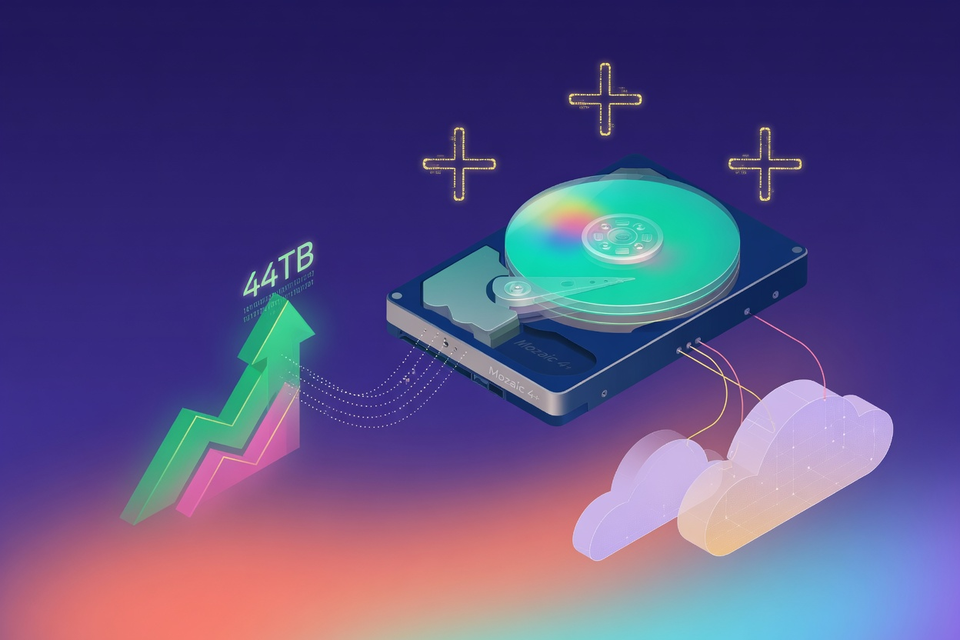
Seagate has qualified its next-generation Mozaic 4+ platform into production at two hyperscale cloud providers, supporting capacities up to 44TB, and will not say which two.
The per-disk figure is the one that carries the roadmap. Seagate puts the platform at 4+TB per disk today and describes a path toward 10TB per disk that would enable drives of up to 100TB. Forty-four divided by a little over four gives ten disks, though the release states no platter count anywhere.
Dave Mosley, Seagate's chair and chief executive officer, put it this way: "Seagate’s HAMR-based Mozaic products deliver the scale, performance, and efficiency customers need to unlock the full potential of their data." Decoded, that is a platform statement rather than a product statement, and the release follows the same pattern throughout. There are no model numbers, no channel or retail SKUs, and no price.
The efficiency claim is where the footnote earns its keep. Seagate says that in a one exabyte deployment, Mozaic improves infrastructure efficiency by approximately 47 percent compared to standard 30TB deployments, cutting required data center footprint by about 100 square feet and annual energy consumption by roughly 0.8 million kilowatt-hours. The endnote supporting all three numbers reads, in full, that the source is a calculation based on internal Seagate documentation resulting from product testing. No methodology, no third party, no workload.
Arithmetic makes the shape of that 47 percent clearer. An exabyte at 44TB per drive is about 22,700 drives; at 30TB it is about 33,300. That is a drive count reduction of roughly 32 percent, not 47. What 44 divided by 30 does produce is 1.47, the per-drive capacity ratio. Seagate does not define what infrastructure efficiency measures here, and the sentence says Mozaic rather than Mozaic 4+, so the capacity actually modelled is not stated either. A hundred square feet of floor saved across an exabyte is also a modest number to lead with.
Vertical integration is the genuinely interesting engineering claim. Seagate designs and manufactures its own laser technology for HAMR recording and says the in-house work strengthens control over yield, reliability and supply chain resilience while shortening qualification timelines and supporting predictable manufacturing economics. Both hyperscale deployments announced here are described as qualifications, which makes that the sentence with the most operational weight in the release.
Two other hardware changes get a single line each in the release, a next-generation suspension architecture and an enhanced system-on-a-chip that Seagate says enables precise recording at higher densities while holding enterprise-class reliability. Neither is quantified.
One vendor superlative deserves flagging. Seagate describes the platform as the industry's only HAMR-based storage platform deployed at scale, which is the company's characterisation and is not substantiated anywhere in the release.
Availability is stated as volume shipments to the two unnamed providers, with broader availability planned as production continues to scale. No date attaches to that, which means anyone outside those two accounts has a capacity roadmap and no purchase order.
Bootnote. The naming is worth a second of attention because it trips people up. The 4+ in Mozaic 4+ refers to areal density expressed as terabytes per disk, not to drive capacity, which is how a platform called 4+ ships a 44TB drive. On Seagate's own stated arithmetic, the 10TB per disk generation is what would put a 100TB drive on a loading dock.



Leave a Reply