
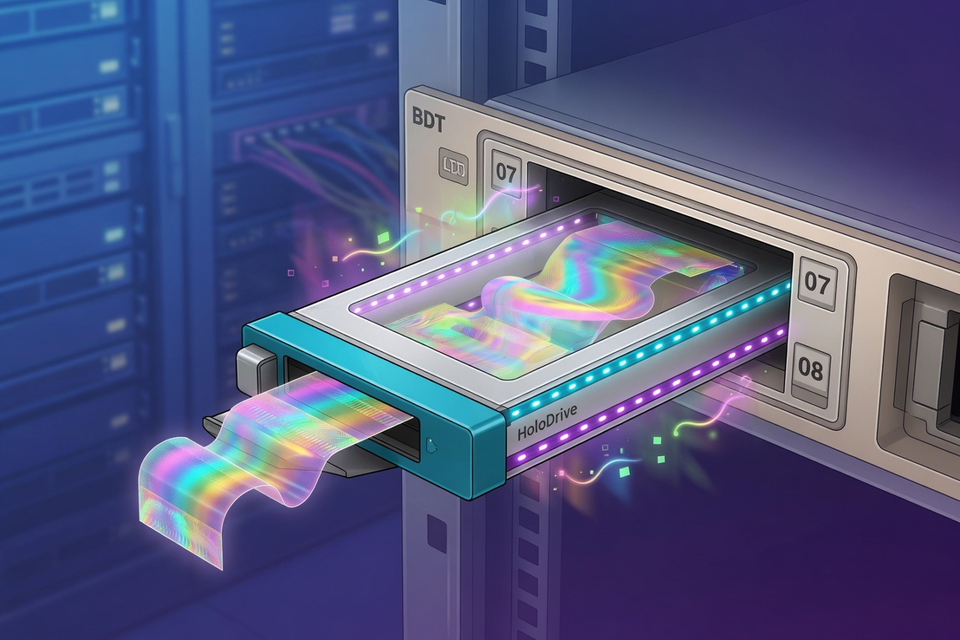
HoloMem has completed the first trial deployment of its HoloDrive and holographic ribbon cartridges inside an existing BDT LTO tape library, running in an operating data center rather than a lab.
Application software wrote and read data to and from the library using either the LTO drives and cartridges or the HoloDrive and its ribbon cartridges, according to Blocks & Files. The HoloMem cartridges share the LTO form factor, so the library robot can pick both and route each to the drive that reads it. BDT Media Automation, the German library maker whose facility hosted the run, has publicly endorsed the result.
The medium is a light sensitive polymer film. A laser induces a chemical state change to write data directly into the film with no post processing step, and HoloMem specifies up to 200 TB per cartridge in WORM format with a life beyond 50 years. Data is encrypted at the drive as it is written. Integration with commonly used backup software interfaces is still in negotiation, TechTarget reports, which is the difference between a drive that works and a drive an archive team can actually schedule.
Charlie Gale, HoloMem's founder and CEO, answered the throughput question in writing. "HoloMem is confident in its roadmap to surpass LTO-10 write and read speeds by the release of its first commercial product," he told TechTarget by email. Read that closely. It is a roadmap statement about a product that does not exist, offered in answer to a question about write speed, and the pilot disclosure carries no measured throughput figure of any kind.
On cost, Gale is more specific. "We're confident that we can present a product offering at a total cost of ownership that comes in around 20% lower than the latest generation of magnetic tape," he told the same publication. Twenty percent is a projection, not a line on a price list, and it is drawn against an unnamed tape generation by a company with nothing in mass production and therefore no volume cost base to price from.
Forrester principal analyst Brent Ellis put the realistic buyer set narrowly. "They probably might fit a state archiving system like the Library of Congress, or university libraries," Ellis told TechTarget, adding medical studies with long retention obligations. He also questioned the 2027 mass production target and flagged write speed, which turns on exposure time, media area and write head configuration. Gale's own framing of the market, in the same piece, is somewhere between five and ten hyperscalers worldwide.
The stated plan is to finish technical feasibility on the first product during 2026, then device integration, then mass production of the HoloDrive in 2027. More pilots are scheduled and the company says some are high profile, a claim carrying no names.
One date deserves attention. TechTarget dates its photograph of a working HoloDrive inside the operating BDT library to December 2025, which places the run itself several weeks before the result was put out. Nothing improper in that, but it means the pilot is older news than the announcement makes it look, and it makes the absence of performance data harder to explain away as early days.
Bootnote: holographic storage has been in development for decades without reaching general use, which is why the interesting part of this pilot is the form factor rather than the physics. HoloMem was founded in 2020 by Gale after roughly a decade of design engineering at Dyson, and he recruited former Dyson colleagues on the reasoning that turning a laboratory result into something manufacturable is a separate discipline from inventing it.




Leave a Reply