
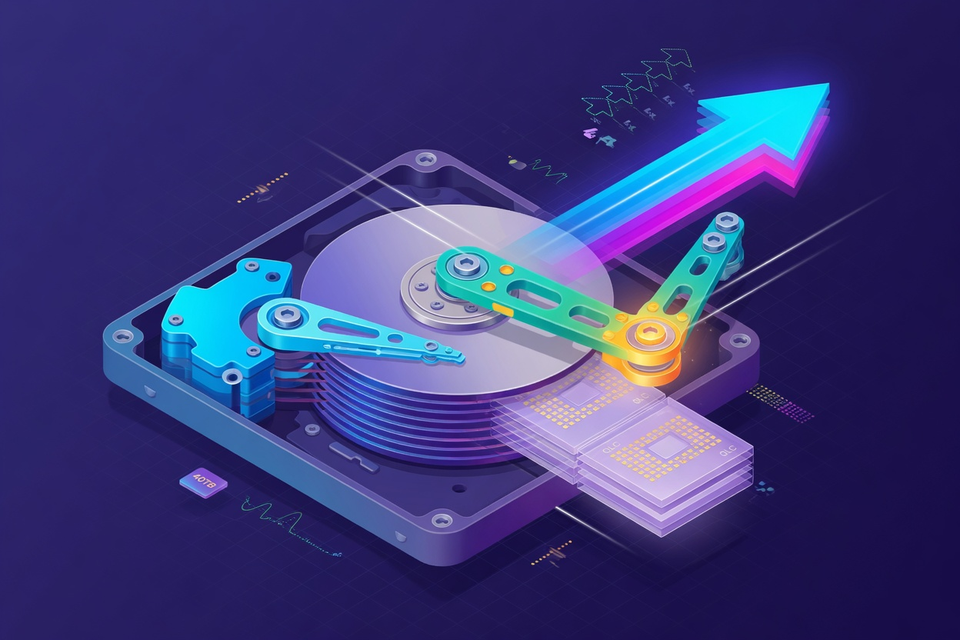
WD is qualifying a 40TB UltraSMR ePMR hard drive at two hyperscale customers and has put two bandwidth technologies on the roadmap that it says will lift sequential I/O by up to 4x when combined.
Volume production of the 40TB drive is planned for the second half of 2026. HAMR drives are in qualification at two hyperscalers as well, with ramp production in 2027, and WD says ePMR will stretch to 60TB using HAMR innovations without raising power draw, while HAMR reaches 100TB by 2029. Both lines share a common architecture, so customers can mix them in one chassis and move at their own pace.
The first bandwidth technology, High Bandwidth Drive, reads and writes from multiple heads on multiple tracks at once instead of parking every head but one. WD claims up to 2x the bandwidth of a conventional drive with no power penalty, a path to 8x, and units already with customers for validation.
Context makes the number legible. Blocks & Files puts most nearline drives at 250 to 275 MB/s and a non-shingled 26TB Ultrastar with 11 platters at up to 302 MB/s, while chief product officer Ahmed Shihab told the publication that customers running QLC flash SSDs get "500 and something megabytes out of those drives" and that with the new technology "you can get 500-plus MB/s." On integration, Shihab said: "There are modifications inside the drive, but we're not redoing anything to the outside. So same interface, same API, same set of commands." Translated, nothing above the drive needs requalifying, the only reason a bandwidth doubling reaches a fleet in months rather than a procurement cycle. It also means SATA link saturation becomes the real ceiling long before the 8x roadmap does.
Dual Pivot is the more aggressive of the two. WD adds a second, independently operating actuator on a separate pivot inside a 3.5-inch enclosure for up to 2x sequential I/O gain, and because the design cuts the spacing between platters it adds capacity rather than sacrificing it. Shihab drew the distinction with earlier attempts: "It's not the same way it was built before, where you had effectively two drives with a SAS interface or two SATA interfaces that was really hard for customers to use. This is a drive you can plug into your existing infrastructure, same software, and just double the I/O." These are in the lab and land in 2028, a long time to hold a claim open.
Power-optimized drives are the quieter announcement, trading minimal random I/O for capacity and much lower power on cold data that still needs sub-second access, and they enter customer qualification in 2027. WD pegs the flash cost premium at 6 to 10 times HDD, the number the whole performance argument rests on and the one most exposed if NAND pricing turns.
Also announced: an intelligent software layer delivered through an open API in 2027 for customers at 200-plus petabytes, with no specification attached to it yet.
The release carries an endorsement from IDC HDD research director Ed Burns, who said WD's Innovation Day "revealed a company that has genuinely transformed its strategy around customer infrastructure needs." Analyst quotes carried in vendor releases are marketing, not research. This one landed alongside a rebrand to WD and a separate board authorization of an additional $4.0 billion of share repurchases, against roughly $484 million left under the prior program.
Bootnote: WD currently builds with 11 platters against Seagate's 10, and Toshiba has demonstrated 12-platter technology. Dual Pivot works by tightening the gap between disks, so the actuator pitched as a performance feature is also a platter-count play.


Leave a Reply