
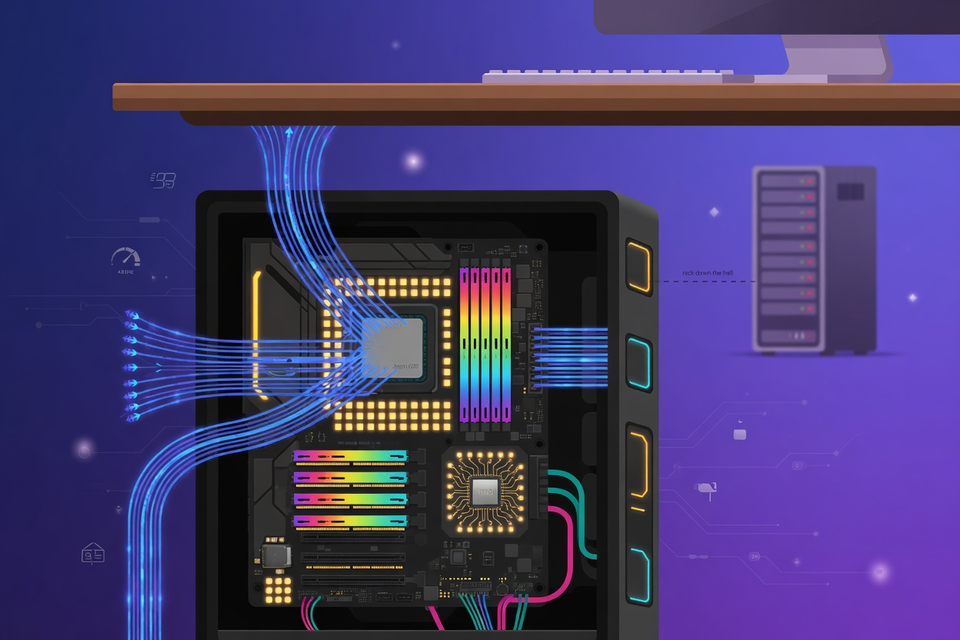
The workstation under the desk has spent a few years quietly losing the compute race to the rack down the hall. Intel would like that to stop. Its new Xeon 600 processors for workstations top out at 86 performance cores at 4.8 gigahertz, 128 lanes of PCIe 5.0 and eight channels of DDR5, which is a server's shopping list wearing a desktop's clothes, all hanging off the W890 chipset.
Hector Guevarez, director of the workstation segment in Intel's Client Computing Group, put the pitch in the language of daily work. "The need for high-performance compute capabilities is increasing daily across a wide range of industries, and with Intel® Xeon® 600 Processors for Workstation we’re delivering the platform professionals need in their daily workflows," he said.
A performance core, P-core in Intel's shorthand, is the big engine in a design that on consumer chips also carries smaller efficiency cores. Picture a kitchen staffed entirely with head chefs and no prep cooks. It costs more, and nobody waits for someone else to finish chopping. The Xeon 600 stack is all P-core, built on the Intel 3 process with a core design Intel calls Redwood Cove+.
Against the previous generation, the company claims up to 9 percent better single-thread and up to 61 percent better multi-thread performance, the second measured on Cinebench 2026 comparing the 86-core Xeon 698X with the 64-core W3595X it replaces, and arriving at existing power consumption targets. Both numbers are Intel's own, with its footnotes pointing to the company performance index for the configurations behind them.
Memory is where the platform changes character. Eight channels of DDR5 registered DIMMs now run at up to 6,400 megatransfers per second, up from 4,800, and the chips add support for MRDIMM, a multiplexed rank DIMM, at speeds up to 8,000. The trick is to have two ranks of memory chips take turns feeding a multiplexer that hands the processor one doubled-up stream. Think of it as a carpool lane for data, and it earns its keep on jobs waiting on memory rather than on arithmetic.
For AI work the family adds FP16 support to AMX, Intel's Advanced Matrix Extensions, the silicon that grinds through the matrix multiplication at the heart of a neural network. FP16 writes a number in 16 bits, half the width of the FP32 older workstation code assumed, so more of them move per clock. Intel puts the gain at up to 17 percent in AI and machine learning workloads on SPECworkstation 4.0.
There is a stunt attached, and it is a good one. Intel and ASUS say they set overclocking world records across 10 benchmarks using a Xeon 698X on an ASUS Pro WS W890E-SAGE SE board, with another 10 global first places beside them. Leaderboard entries are not a warranty, and Intel's own small print notes that altering clock frequency or voltage may void product warranties.
Availability is the line buyers will read twice. Intel says the parts reach OEM and system integrator partners and boxed retail beginning in late March, with five processors boxed for individual sale, from the 18-core Xeon 654 up to the 64-core Xeon 696X. The 86-core flagship is not on that list, so the biggest one arrives inside somebody else's chassis.
Underneath all of it sits a bet that a slice of AI development stays local. Renting GPUs by the hour is easy; feeding a pile of them from a desk-side machine with 128 PCIe lanes is what Intel is selling against that convenience. Whether enough professionals still want a tower humming beside them is the question this stack has to answer.



Leave a Reply