
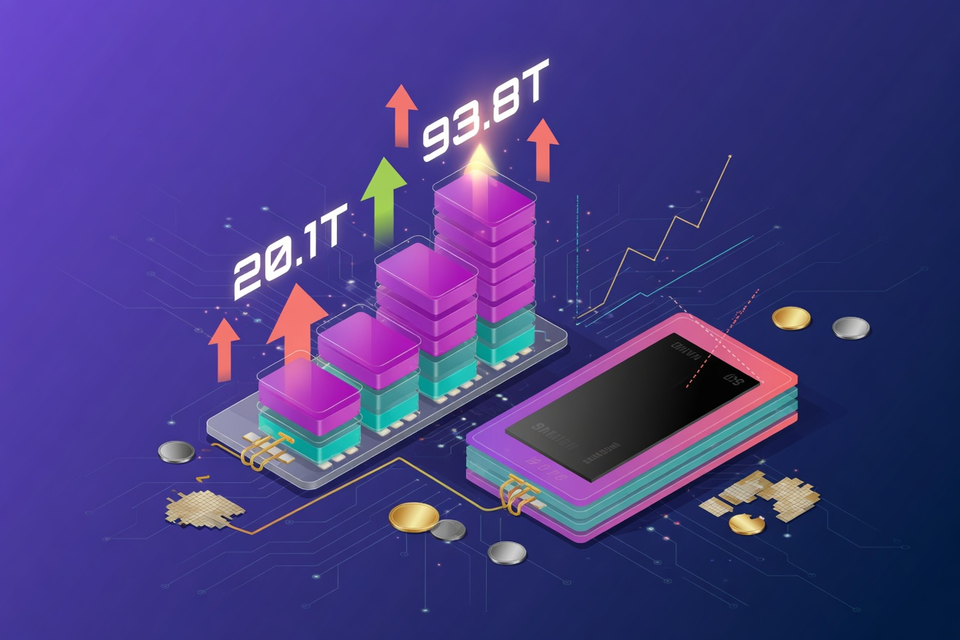
Samsung Electronics posted an all-time high quarterly operating profit of KRW 20.1 trillion on record revenue of KRW 93.8 trillion for the quarter ended December 31, taking full-year revenue to KRW 333.6 trillion and full-year operating profit to KRW 43.6 trillion.
The Device Solutions division booked KRW 44.0 trillion of that revenue and KRW 16.4 trillion of the operating profit. Semiconductors therefore delivered a little over 80 percent of group profit on under half of group revenue. The rest of the company, from phones to panels to Harman, supplied the remaining fifth.
Memory set the records. The release says the business hit "an all-time high for quarterly revenue and operating profit, driven by expanded sales of HBM and other high-value-added products, as well as the overall market price surge." Mix is named first and price second, and nowhere does the release say how the gain divides between them.
What it also does not say is what the Memory Business earned. Blocks and Files notes that Samsung has broken out memory revenue in the past and did not this time, and quotes a Counterpoint Research estimate of KRW 37.1 trillion. An estimate is not a disclosure. A company reporting the best memory quarter in its history rarely withdraws the number unless the comparisons that number invites have become awkward.
The HBM paragraph is the one to read twice. Samsung says it is on track to begin delivering HBM4 this quarter, with performance figures attached, and states the goal as "reestablishing a leadership position in the high-end HBM market." Reestablishing is a concession. A supplier holding the high-end position defends it rather than reclaims it.
On NAND the stated plan is "scaling up sales of high-performance TLC products for Key Value SSD demand for inference." That is a bet on inference caches rather than training scratch capacity, and it is a TLC bet specifically. QLC goes unmentioned in the release, which is a conspicuous gap for a supplier chasing capacity tiers.
Foundry revenue rose on demand from major markets, but Samsung says "earnings improvement was limited as a result of provisional costs" and attaches no figure to them. The same division commenced mass production of first-generation 2nm products and began shipping 4nm HBM base dies, which puts Samsung logic underneath Samsung memory stacks and gives the foundry an anchor customer it does not have to win.
Elsewhere the quarter reads less well. Device eXperience revenue fell 8 percent sequentially on weaker launch effects and competition. The visual display and digital appliance businesses together recorded a KRW 0.6 trillion operating loss. Research and development ran to KRW 10.9 trillion in the quarter alone, KRW 2 trillion more than the previous three months, for a full-year record of KRW 37.7 trillion.
Bootnote: Samsung reports in won and leaves the conversion to everyone else, which is why the same quarter appears in three different dollar figures depending on the outlet and the day. On the rate Blocks and Files used, the December quarter was worth roughly $65.6 billion of revenue and $14.1 billion of operating profit, and the year about $233.2 billion.



Leave a Reply