
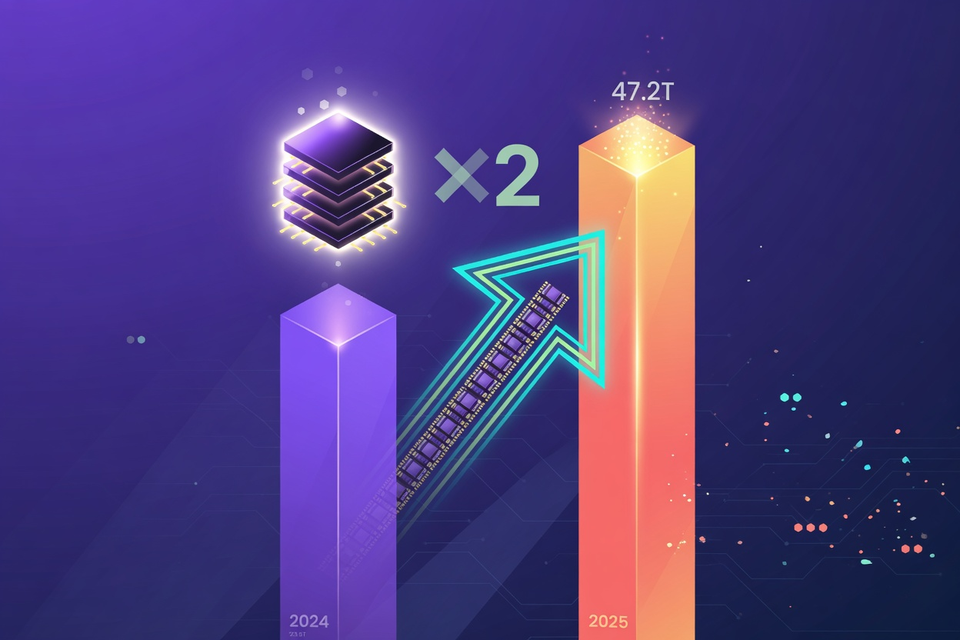
SK hynix reported 2025 operating profit of 47.2063 trillion won, slightly more than double the 23.4673 trillion won it booked in 2024.
Revenue reached 97.1467 trillion won against 66.1930 trillion won a year earlier, an increase of 47 percent, at an operating margin of 49 percent. Net profit was 42.9479 trillion won, a 44 percent net margin.
The fourth quarter did the heavy lifting. Revenue rose 34 percent quarter on quarter to 32.8267 trillion won and operating profit rose 68 percent to 19.1696 trillion won, taking the quarterly operating margin to 58 percent. Both beat LSEG SmartEstimates of 32.132 trillion won and 17.729 trillion won, CNBC reports.
Operating profit growing at twice the rate of revenue is a pricing outcome, not a volume one. The company credits HBM revenue more than doubling year on year, but it also says demand for conventional server memory rose sharply in the quarter and that it responded proactively. That is where the quarter's margin expansion came from. HBM is contracted ahead of shipment; commodity server DRAM reprices in the quarter it sells.
Song Hyun Jong, President and Head of Corporate Center, said the company will keep generating growth while balancing future investment, financial stability and shareholder returns. "We will strengthen our role not merely as a product supplier, but as a core infrastructure partner in the AI era, enabling customers to meet their AI performance requirements."
Infrastructure partner is procurement language. It describes the move away from spot-priced components toward multi-year allocation agreements, which is how memory gets sold when buyers cannot source enough of it and are willing to commit early to avoid being last in the queue.
CNBC quotes Ray Wang, an analyst at SemiAnalysis focused on memory and the AI supply chain, saying: "Beyond HBM, commodity DRAM will be a critical earnings driver this year, supported by rapidly expanding margins and demand stemming from a structural supply shortage." The margin half of that sentence is the load-bearing half. If conventional DRAM carries earnings, the exposure shifts toward the part of the portfolio that is not locked into long agreements, which cuts both ways.
Shareholders take 1 trillion won in additional dividends, or 1,500 won per share, bringing the FY2025 total to 3,000 won per share and 2.1 trillion won in aggregate. The larger figure is the cancellation of 15.3 million treasury shares, 2.1 percent of shares outstanding and roughly 12.2 trillion won at the closing price on the 27th. That is retirement of stock the company already holds rather than a new buyback authorisation, and it amounts to about a quarter of the year's operating profit.
Capacity is the constraint the company keeps naming. It plans to maximise output at the M15X fab in Cheongju at an early stage and to secure mid-to-long-term capability through the first fab in the Yongin Semiconductor Cluster. Conventional DRAM moves to the 1cnm process, NAND transitions to 321-layer, and SK hynix says it completed preparation to mass produce HBM4 in September last year, first in the industry, with large-scale production now under way.
Absent from the release is a capex figure, a bit-growth outlook or any pricing guidance, so the size of the supply response those fabs represent is unstated.
Bootnote: the release glosses 1cnm as the sixth generation of 10-nanometre class technology, which is why the industry writes it as a letter rather than a number. The 256GB DDR5 RDIMM the company developed in 2025 is built on 32Gb 1b DRAM, the fifth generation, a useful reminder that the highest-capacity server modules do not automatically ride the newest node.

Leave a Reply