
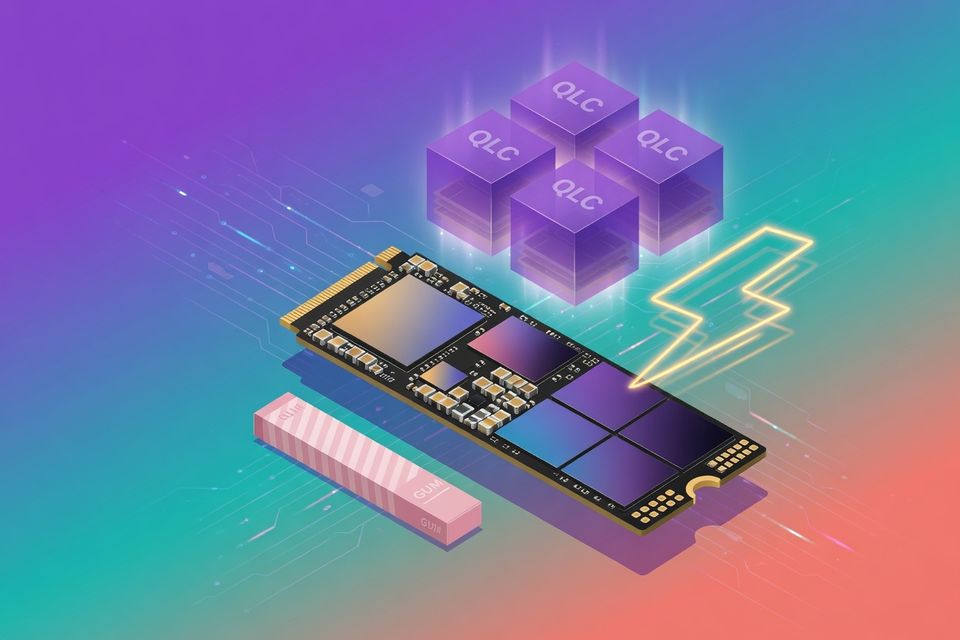
Micron announced the 3610, the first SSD to pack 4TB of QLC NAND into a single-sided M.2 2230 module, at CES 2026. That form factor is smaller than a stick of gum and normally tops out well below 4TB, so the density claim is the real news here, not the raw speed numbers.
"The 3610 SSD combines cutting-edge PCIe Gen5 technology, Micron's most-advanced G9 QLC NAND, and a sleek, single-sided design to deliver premium performance, capacity, and power efficiency," said Mark Montierth, senior vice president of Micron's Mobile and Client Business Unit. "The 3610 will enable ultra-thin devices that meet the growing demands of on-device AI, immersive streaming, and performance-intensive workloads." Strip the marketing framing and the actual news is that Micron is willing to sell QLC, the four-bit-per-cell NAND that trades endurance and often speed for density, into a segment that has mostly stuck with three-bit TLC for anything performance-sensitive.
Sequential numbers make the trade-off clear: 11,000 MB/s read and 9,300 MB/s write, built on Micron's G9 NAND. That falls short of the 14,500 MB/s and 12,000 MB/s Micron already claims for its TLC-based 4600 SSD, which ships in the larger 2280 form factor and also tops out at 4TB. The 3610 is not the fastest drive Micron sells; it is the densest one that fits where a 2280 module physically cannot. Micron also has not published a random IOPS figure for the 3610, a number it does disclose for the 4600 at 2.1 million, which leaves buyers comparing sequential throughput alone until OEMs get their own samples.
Single-sided M.2 2230 is the constraint that makes this launch worth noting rather than just another SSD refresh. It is the form factor used in handheld gaming PCs and the thinnest ultrabooks, where there is no room for chips on both sides of the board and every millimeter of space is already spoken for. Micron says no drive, QLC or TLC, has previously reached 4TB in that exact footprint; the 3610's pitch to OEMs is capacity headroom that single-sided 2230 designs did not have before, not a straight speed upgrade over what already shipped.
A claimed twenty-billion-parameter model load in under three seconds carries no disclosed benchmark or methodology, and a separate figure, 43 percent better performance per watt, does not specify what baseline it was measured against. Neither number is independently verified.
Pricing and availability were not part of the announcement. Micron says the 3610 remains under OEM evaluation, the standard holding pattern before a client SSD shows up in shipping laptops and handhelds rather than press decks.
Bootnote: QLC's reputation problem predates this launch by years. Cramming four bits into a NAND cell instead of three raises capacity per wafer and lowers cost, but it narrows the voltage margin between states, which is why QLC drives have historically shown lower write endurance and slower sustained writes than TLC parts. Micron pairing QLC with Gen5 and a flagship-adjacent spec sheet is a bet that G9 NAND has closed enough of that gap to matter to OEMs, not just to spreadsheet comparisons.




Leave a Reply